

Run Recipes
Run Recipes is the section used to create and manage configurations that define how Docker images are run on a cluster within a Code Flow.
A Run Recipe defines the Docker image to be run, the cluster on which it will run, source and target dependencies, CPU and memory resources, and environment variables.
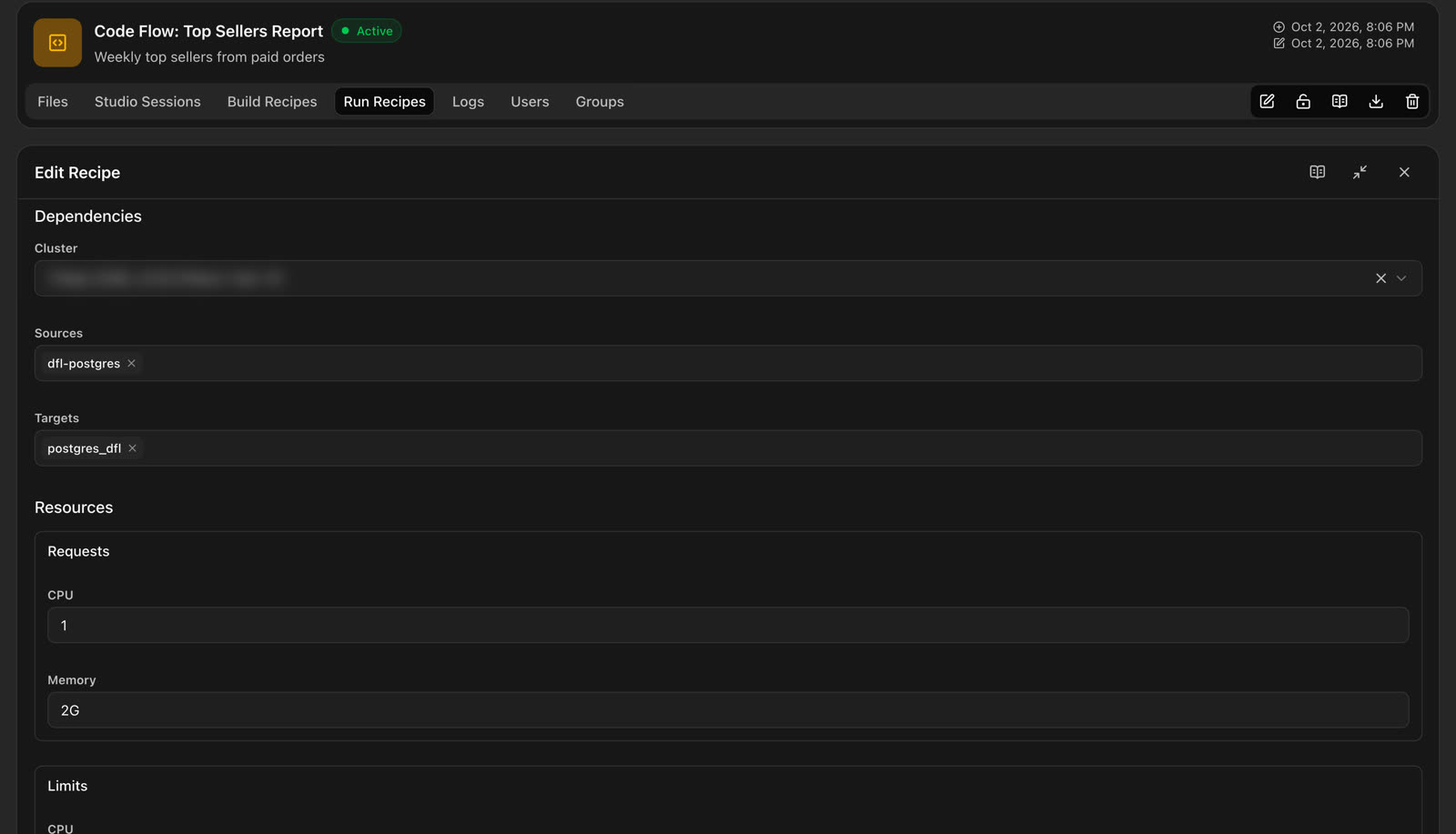
The prepared recipe determines the runtime configuration used when the Docker image runs on the cluster.
Run Recipes Page
The Run Recipes page is used to view and manage runtime configurations created within the related Code Flow.
Existing recipes can be displayed in List View or Card View.
To create a new runtime configuration, use the Add Recipe button in the upper-right section of the page.
List View
In List View, Run Recipes are displayed in a table.
The following information is displayed:
| Column | Description |
|---|---|
| Image Type | Displays the type of the Docker image and the related image information. |
| Image Pull Secret Name | Displays the secret name used when pulling the Docker image. |
| CPU | Displays the CPU request and limit values defined for the runtime. |
| Memory | Displays the memory request and limit values defined for the runtime. |
| Create Date | Displays the date and time when the recipe was created. |
| Update Date | Displays the date and time when the recipe was last updated. |
| Status | Displays the current status of the recipe. |
The three-dot menu on the right side of each record provides access to the available actions for the recipe.
Card View
Run Recipes can also be displayed as cards.
Each card contains the basic runtime information of the recipe.
| Field | Description |
|---|---|
| Image Type | Displays the type of the Docker image to be run. |
| Image Information | Displays the image or related image information that will be used. |
| Image Pull Secret Name | Displays the secret name used to pull the Docker image. |
| CPU | Displays the CPU request and limit values. |
| Memory | Displays the memory request and limit values. |
| Create Date | Displays the date and time when the recipe was created. |
| Update Date | Displays the date and time when the recipe was last updated. |
| Status | Displays the current status of the recipe. |
The three-dot menu in the upper-right section of the card provides access to the available actions for the recipe.
View Options
The Run Recipes page supports two different view types:
- List View
- Card View
The view buttons in the upper-right section of the page can be used to switch between the two views.
Changing the view only changes how the recipes are displayed.
Quick Search
The Filter... field in the upper-right section of the page can be used to quickly search through Run Recipes.
When a value is entered into the search field, the displayed records are narrowed down to matching recipes.
This feature makes it easier to find a specific configuration when many Run Recipes are available.
Advanced Filtering
The Filter button next to the quick search field can be used for more detailed filtering.
Filter options can be used to display Run Recipes that match specific criteria.
Multiple filter conditions can be used to narrow down the results further.
Active filters can be cleared when necessary to display all recipes again.
Adding a Run Recipe
The Add Recipe button is used to create a new runtime configuration.
When creating a Run Recipe, the information that determines where and with which resources the Docker image will run is configured.
The configuration mainly consists of image settings, dependencies, resources, and environment variables.
Image
The Image section is used to specify the Docker image that will run on the cluster.
Image Type
The Type field determines how the Docker image to be run is provided.
The related image information is configured according to the selected image type.
For example, when Build is selected, a previously built Docker image can be selected and used in the Run Recipe.
Build
When the image type is Build, the previously built Docker image to be run can be selected from this field.
This associates the existing Docker image with the Run Recipe so that it can be run on the cluster.
The basic relationship can be summarized as:
Docker Image → Run Recipe → Cluster
Image Pull Secret Name
The Image Pull Secret Name defines the secret name used when pulling the Docker image from the related registry.
This information is used when required to allow the cluster to access the Docker image.
Dependencies
The Dependencies section is used to specify the system resources that will be available when the Docker image is run.
Cluster
The Cluster field determines the cluster on which the Docker image will run.
When the Run Recipe is used, the related Docker image runs on the selected cluster.
Sources
The Sources field is used to specify the data sources that will be available to the running Docker image.
One or more Sources can be included in the Run Recipe.
Targets
The Targets field is used to specify the data targets that will be available to the running Docker image.
One or more Targets can be included in the Run Recipe.
Resources
The Resources section is used to define the CPU and memory values available when the Docker image runs on the cluster.
Resource values are configured in two sections: Requests and Limits.
Requests
Requests define the CPU and memory resources requested for the runtime.
| Field | Description |
|---|---|
| CPU | Specifies the amount of CPU requested for the runtime. |
| Memory | Specifies the amount of memory requested for the runtime. |
Limits
Limits define the maximum CPU and memory resources that the runtime can use.
| Field | Description |
|---|---|
| CPU | Specifies the maximum amount of CPU that the runtime can use. |
| Memory | Specifies the maximum amount of memory that the runtime can use. |
In List View and Card View, CPU and memory values are displayed together as request and limit values.
For example:
CPU: Request / Limit
Memory: Request / Limit
Environment Variables
The Environments section is used to define environment variables that will be available when the Docker image runs.
Each environment variable consists of a name and value pair.
| Field | Description |
|---|---|
| Name | Specifies the name of the environment variable. |
| Value | Specifies the value assigned to the environment variable. |
New environment variables can be added, and existing environment variables can be removed.
The defined environment variables are passed to the runtime environment when the Docker image is started.
Saving a Recipe
After the runtime configuration is completed, use the Save button to save the recipe.
The saved recipe is displayed on the Run Recipes page.
The Cancel option can be used to leave the creation page without saving the changes.
Runtime Process
A Run Recipe defines the cluster and runtime configuration used to run a prepared Docker image.
The selected Docker image, cluster, CPU and memory resources, dependencies, and environment variables are used to configure the runtime environment.
The general process can be summarized as:
Docker Image → Run Recipe → Cluster → Running Docker Image
The overall process from building a Docker image with a Build Recipe to running it can be summarized as:
Build Recipe → Docker Image → Run Recipe → Cluster → Running Docker
        Image
Status
The current status of each Run Recipe is displayed in both List View and Card View.
A recipe with an Active status indicates that the recipe is active in the system.
Status information makes it possible to identify the current state of recipes directly from the Run Recipes page.
Pagination
Pagination controls are available at the bottom of the Run Recipes page.
The total number of recipes is displayed in the lower-left section.
For example:
Total 5 records
The pagination controls in the center can be used to:
- Go to the first page.
- Go to the previous page.
- Go to the next page.
- Go to the last page.
- View the current page and the total number of pages.
The Rows per page option in the lower-right section can be used to change the number of Run Recipes displayed on each page.